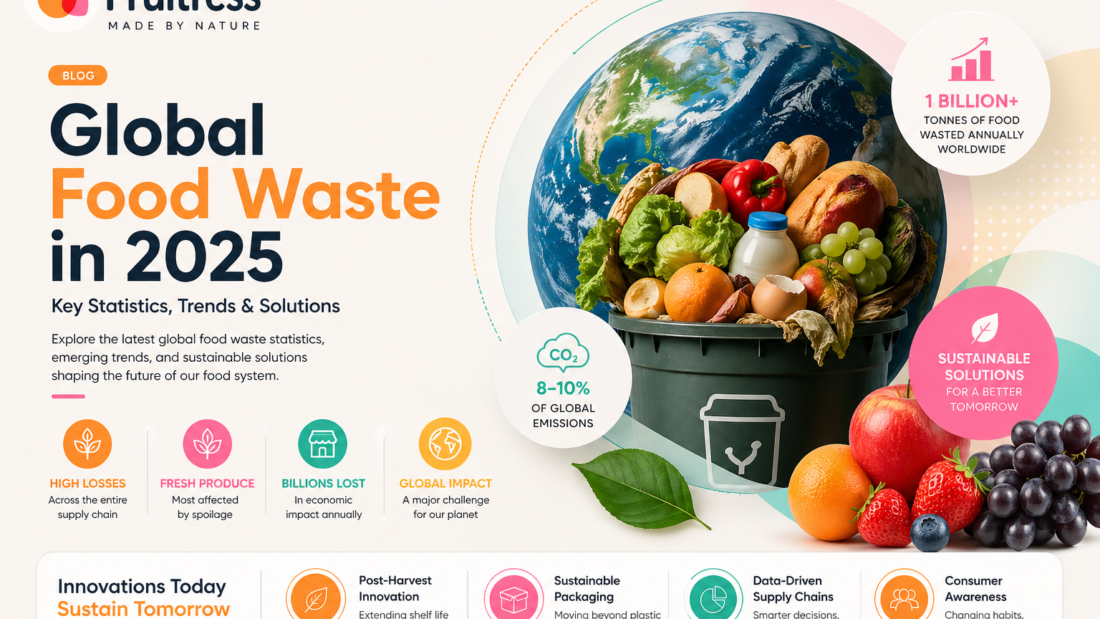
Infographic visualization showing the global food supply chain, highlighting the impact of post-harvest waste and innovative preservation solutions.

The Global Food Waste Crisis: 2025 Challenges and Innovation Trends

Food waste remains one of the most urgent and overlooked challenges in the global food system. In 2025, despite significant strides in agricultural efficiency and digital logistics, a massive portion of the world’s food production never reaches the consumer’s plate.

Understanding the scale, the underlying causes, and the emerging technological trends is essential—not only for policymakers but for every stakeholder in the supply chain, from farmers to food-tech innovators.


The Scale: How Much Food Is Wasted Globally?

Recent data indicates that more than 1 billion tonnes of food are wasted annually worldwide. This represents nearly 20% of all food available to consumers—a staggering figure that translates into massive economic and environmental losses.

This waste is systemic and occurs at every touchpoint:

  • On-Farm: Harvesting inefficiencies and grading standards.
  • Logistics: Spoilage during transit due to temperature fluctuations.
  • Retail: Overstocking and rigid aesthetic standards.
  • Consumer: Purchasing habits and improper storage.

Regional Disparities: A Tale of Two Systems

While food waste is a global pandemic, its drivers differ drastically by geography:

Developed Markets (North America, Europe)

Waste is concentrated at the retail and consumer levels. It is often driven by “cosmetic perfection” (discarding produce that doesn’t meet visual standards) and high-volume over-purchasing.

Emerging Markets (Asia, Latin America, Africa)

The primary challenge is post-harvest loss. Due to limited cold-chain infrastructure and inefficient transport, produce often spoils before it can even leave the production region.


The Hidden Cost: Environmental Impact

Food waste is not just a logistical failure; it is a major climate driver. When food is discarded, the resources used to grow it—water, land, labor, and fuel—are squandered.

Furthermore, organic waste in landfills generates methane, a potent greenhouse gas. Globally, food waste contributes approximately 8–10% of total greenhouse gas emissions, making it a critical focus area for climate change mitigation in 2025.

Why Fresh Produce Is the Most Vulnerable

Fresh fruits and vegetables are highly perishable. They continue to “live” and breathe (respiration) after harvest. Key spoilage factors include:

  • Moisture Loss: Leading to shriveling and weight reduction.
  • Oxidation: Causing browning and nutrient loss.
  • Ethylene Sensitivity: Accelerating the ripening cycle.

2025 Trends: Shifting the Paradigm

As the industry pivots toward sustainability, four trends are leading the reduction movement:

  1. Advanced Post-Harvest Tech: Moving beyond basic cold storage.
  2. Sustainable Packaging: A rapid shift from plastic toward bio-based, edible alternatives.
  3. Data-Driven Supply Chains: Using AI for predictive inventory management.
  4. Conscious Consumerism: Growing market demand for sustainability-backed products.

The Breakthrough: Edible Coatings

One of the most promising solutions in 2025 is the integration of plant-based edible coatings. By creating an invisible, breathable barrier, these coatings regulate moisture, oxygen, and ethylene—effectively “pausing” the aging process of produce.

Is Your Supply Chain Optimized for 2025?

Innovations like Fruitress are enabling producers and distributors to deliver fresher, longer-lasting products while significantly reducing the carbon footprint of their operations.

Schedule a Consultation

Conclusion

Food waste in 2025 is a critical challenge, but it is also an unparalleled opportunity for innovation. By combining smarter logistics, data-driven decisions, and sustainable technology, the food industry can move toward a future where less is wasted and more is preserved.
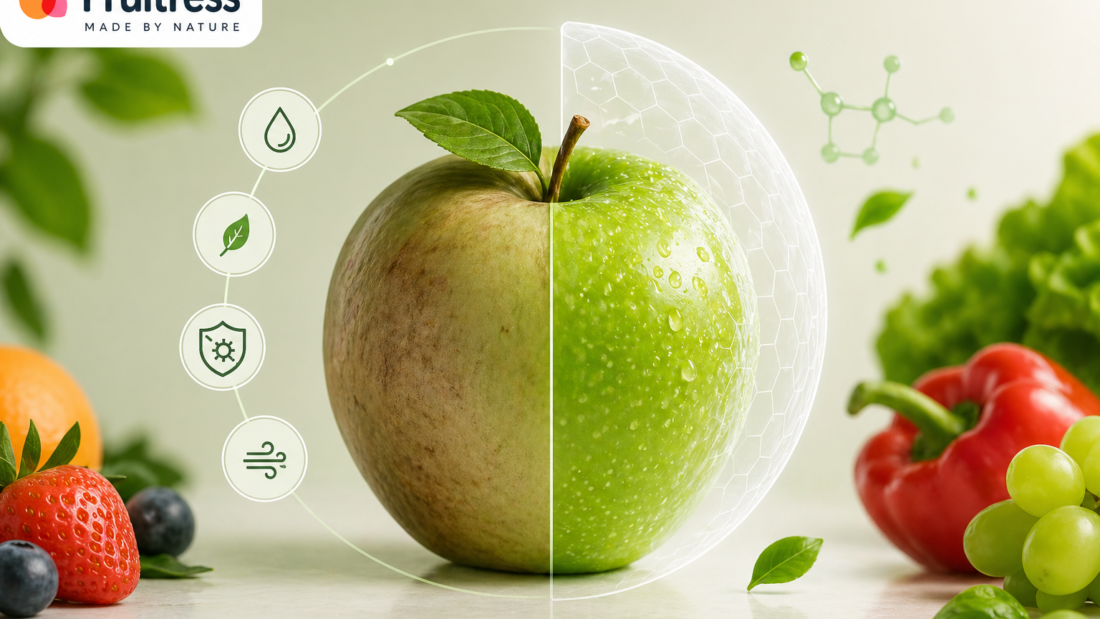
Cross-section scientific illustration showing how Fruitress edible bio-coating creates a protective barrier on fresh fruit against moisture loss and oxidation

How Edible Coatings Work: The Science Behind Longer-Lasting Fresh Produce

Fresh fruits and vegetables begin to deteriorate the moment they are harvested. Despite continuous advances in cold-chain logistics, post-harvest losses remain one of the most critical economic and environmental bottlenecks across the global food supply chain.

In recent years, edible coating technology has emerged as a groundbreaking, sustainable standard to extend shelf life, reduce food waste, and preserve produce quality—without relying on single-use plastics or synthetic chemicals.

But how exactly do edible coatings work at a physiological level? Let’s dive into the science.


What Are Edible Coatings?

Edible coatings are micro-thin, invisible layers formulated from natural, food-grade biopolymers applied directly onto the surface of whole or fresh-cut produce.

Functioning as an artificial “second skin,” these coatings enhance the fruit’s natural cuticle to:

  • Retain internal moisture and prevent dehydration
  • Moderate cellular respiration and gas exchange
  • Inhibit oxidative browning and degradation
  • Suppress microbial colonization and fungal growth

Unlike conventional petroleum-based packaging or toxic synthetic waxes, advanced edible coatings are completely biodegradable, clean-label, and safe for consumption along with the fruit.


The Mechanism: 4 Pillars of Produce Protection

Post-harvest senescence (aging) is driven by metabolic and biochemical processes. Edible coatings slow down these processes through four critical mechanisms:

1. Moisture Retention & Transpiration Control

Water evaporation is the leading cause of post-harvest weight loss and shriveling. As produce loses moisture, it suffers from structural collapse, visual shrinkage, and reduced commercial weight.

Bio-coatings form a semi-permeable lipid-polysaccharide barrier that significantly retards water vapor transmission, ensuring fruit stays firm, crisp, and heavy until it reaches consumers.

2. Regulating Gas Exchange & Oxidation

Exposure to atmospheric oxygen triggers rapid cellular breakdown, causing:

  • Enzymatic browning (especially in apples, avocados, and pears)
  • Breakdown of vitamins (particularly Vitamin C)
  • Off-flavor development

By creating a selective barrier to O2 and CO2, edible coatings limit oxygen penetration, effectively slowing down oxidative reactions without causing internal fermentation or anaerobic decay.

3. Ethylene Regulation (Ripening Control)

Ethylene is the endogenous plant hormone that triggers ripening, softening, and eventually rot. By controlling respiration rates and internal gas concentrations, bio-coatings slow down the autocatalytic production of ethylene, keeping produce in a stable, pre-climacteric state for extended durations.

4. Microbial Defense & Structural Integrity

Surface micro-fractures serve as entry gates for opportunistic mold spores (like Botrytis and Penicillium). Advanced formulations integrate natural antimicrobial agents that create an inhospitable surface environment for bacteria and fungi, preventing decay before it spreads.

Key Takeaway for Commercial Operations

Preserving physical attributes is directly tied to profit margins. A 2x increase in shelf life gives exporters flexible shipping windows and slashes retail shrinkage rates by up to 40%.


Formulation: What Are Modern Coatings Made Of?

Commercial bio-coatings are engineered from natural, food-derived building blocks tailored to specific produce varieties:

  • Polysaccharides (Cellulose, Starch, Chitosan): Provide excellent gas barrier properties and mechanical stability.
  • Lipids & Waxes (Plant Oils, Carnauba): Deliver supreme moisture barriers to arrest dehydration.
  • Plant Proteins: Form cohesive, flexibleExposure to atmospheric oxygen triggers rapid cellular breakdown, causing:
    • Enzymatic browning (especially in apples, avocados, and pears)
    • Breakdown of vitamins (particularly Vitamin C)
    • Off-flavor development

    By creating a selective barrier to O2 and CO2, edible coatings limit oxygen penetration, effectively slowing down oxidative reactions without causing internal fermentation or anaerobic decay.

    3. Ethylene Regulation (Ripening Control)

    Ethylene is the endogenous plant hormone that triggers ripening, softening, and eventually rot. By controlling respiration rates and internal gas concentrations, bio-coatings slow down the autocatalytic production of ethylene, keeping produce in a stable, pre-climacteric state for extended durations.

    4. Microbial Defense & Structural Integrity

    Surface micro-fractures serve as entry gates for opportunistic mold spores (like Botrytis and Penicillium). Advanced formulations integrate natural antimicrobial agents that create an inhospitable surface environment for bacteria and fungi, preventing decay before it spreads.

    Key Takeaway for Commercial Operations

    Preserving physical attributes is directly tied to profit margins. A 2x increase in shelf life gives exporters flexible shipping windows and slashes retail shrinkage rates by up to 40%.


    Formulation: What Are Modern Coatings Made Of?

    Commercial bio-coatings are engineered from natural, food-derived building blocks tailored to specific produce varieties:

    • Polysaccharides (Cellulose, Starch, Chitosan): Provide excellent gas barrier properties and mechanical stability.
    • Lipids & Waxes (Plant Oils, Carnauba): Deliver supreme moisture barriers to arrest dehydration.
    • Plant Proteins: Form cohesive, flexible #cbd5e1; color: #dc2626;”>High Waste / Non-RenewableModerateConsumer SafetyClean-Label & Food-GradeHigh (External)Chemical Residue ConcernsCarbon ImpactModerateConsumer SafetyClean-Label & Food-GradeHigh (External)Chemical Residue ConcernsCarbon ImpactMinimalExtremely HighMediumSupply Chain Scalability
      Ready to integrate bio-coatings into your packhouse workflow?Get in Touch with Our Agritech Team
    • Discover how Fruitress custom formulations can double your produce shelf life and minimize post-harvest loss.