The global agricultural sector faces a staggering, continuous challenge: post-harvest waste. From the moment fruits and vegetables are harvested, they begin a race against time. Moisture loss, oxidation, rapid ethylene production, and microbial contamination quickly degrade their quality, leading to premature spoilage. For supply chain managers, exporters, and retailers, this isn’t just about fruit rot—it’s about the systemic erosion of profit margins and the failure to meet global food security goals.
Traditionally, the industry has relied on synthetic waxes, chemical treatments, or single-use plastic packaging to slow this deterioration. While these methods provided a temporary shield, they came with significant drawbacks: high disposal costs, environmental scrutiny, and the risk of trapping moisture that accelerates mold growth. Today, however, a cleaner, smarter, and highly sustainable technology is taking center stage: edible, plant-based coatings.
The Macro-Economic Perspective: The Hidden Cost of Waste
Food waste is frequently viewed through the lens of lost inventory. However, in the modern supply chain, this is a dangerous oversimplification. When a shipment of produce is discarded, the economic loss extends far beyond the raw product. It encompasses the water used for irrigation, the energy expended in temperature-controlled storage, the fuel consumed during logistics, and the labor costs associated with sorting and handling.
Economically, post-harvest loss is a multiplier effect. By mitigating spoilage at the source, stakeholders not only preserve the commodity itself but also protect the capital investment embedded within every stage of the supply chain. This is why major global exporters are shifting their focus from “managing waste” to “preventing degradation” before it begins.
The Science: Post-Harvest Physiology
To understand why edible coatings are a breakthrough, we must look at the biology of harvested crops. Fruits and vegetables are “living” tissues. Even after they are detached from the parent plant, they continue to respire—they consume oxygen and release carbon dioxide and water vapor.
This process of respiration is the biological engine of ripening and, ultimately, senescence (aging). When respiration rates are high, produce ages rapidly. Furthermore, the skin of a fruit is its primary line of defense against microbial pathogens and dehydration. In commercial harvesting and cleaning processes, the natural waxy cuticle of a fruit is often damaged or stripped away. Edible coatings act as a “bio-mimicry” layer, reconstructing this natural barrier to restore the fruit’s ability to defend itself.
Beyond Synthetic Waxes: The Shift to Bio-polymers
For decades, petroleum-based synthetic waxes were the industry standard. While effective at creating a shine, they often “suffocate” the produce. If the barrier is too impermeable, the fruit cannot breathe, leading to internal fermentation, off-flavors, and reduced nutrient density.
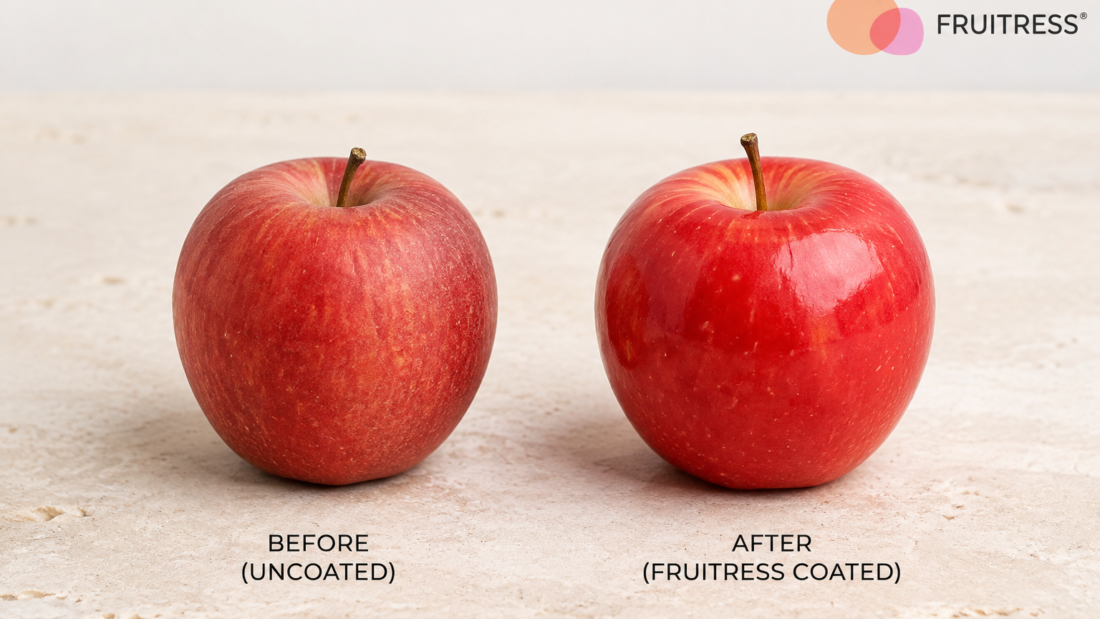
Modern edible coatings, such as those utilized by Fruitress, employ advanced formulations of natural plant lipids and proteins. These coatings create a semi-permeable film. This film is “intelligent”—it is structured to be thin enough to allow for essential gas exchange (respiration) while remaining dense enough to block external moisture loss and prevent the penetration of bacteria and fungal spores.
Strategic Integration in the Digital Supply Chain
The role of edible coatings is evolving alongside the digitization of the supply chain. Today’s sophisticated cold chains rely on IoT (Internet of Things) sensors to monitor temperature and humidity. However, these sensors only track the environment; they cannot protect the product from the internal physiological changes that lead to decay.
Edible coatings serve as the necessary “micro-level” partner to “macro-level” digital tracking. While temperature sensors identify potential risks, the coating acts as a proactive buffer, increasing the produce’s resilience against inevitable minor temperature fluctuations that occur during transit. This synergy between physical preservation technology and digital logistics is the cornerstone of the next generation of AgriTech.
Sustainability as a Competitive Advantage
The global push for sustainability is no longer merely a public relations campaign; it is a regulatory requirement. From the EU’s “Farm to Fork” strategy to global initiatives aimed at reducing the carbon footprint of retail, supply chains are under immense pressure to decouple growth from plastic waste.
Edible coatings provide a tangible solution to this transition. By reducing the reliance on single-use plastics and clamshells, companies can demonstrate a measurable reduction in their carbon footprint. This alignment with ESG (Environmental, Social, and Governance) goals is becoming a decisive factor in commercial partnerships, where retailers increasingly prioritize suppliers who can offer “clean” and transparent supply chains.
The Future of Post-Harvest Preservation
The transition toward edible coatings marks a fundamental shift in how the industry handles perishables. We are moving from a model of reactive preservation—trying to save produce once it has begun to degrade—to a model of proactive protection. By enhancing the fruit’s own natural capabilities, we can decouple long-distance trade from high spoilage rates.
As the agricultural sector continues to grapple with the demands of a growing population and the unpredictability of global logistics, the focus will inevitably turn toward smarter, cleaner, and more resilient solutions. The adoption of plant-based protection is not just an incremental improvement in shelf-life; it is a structural change in how we ensure food security for the global market.