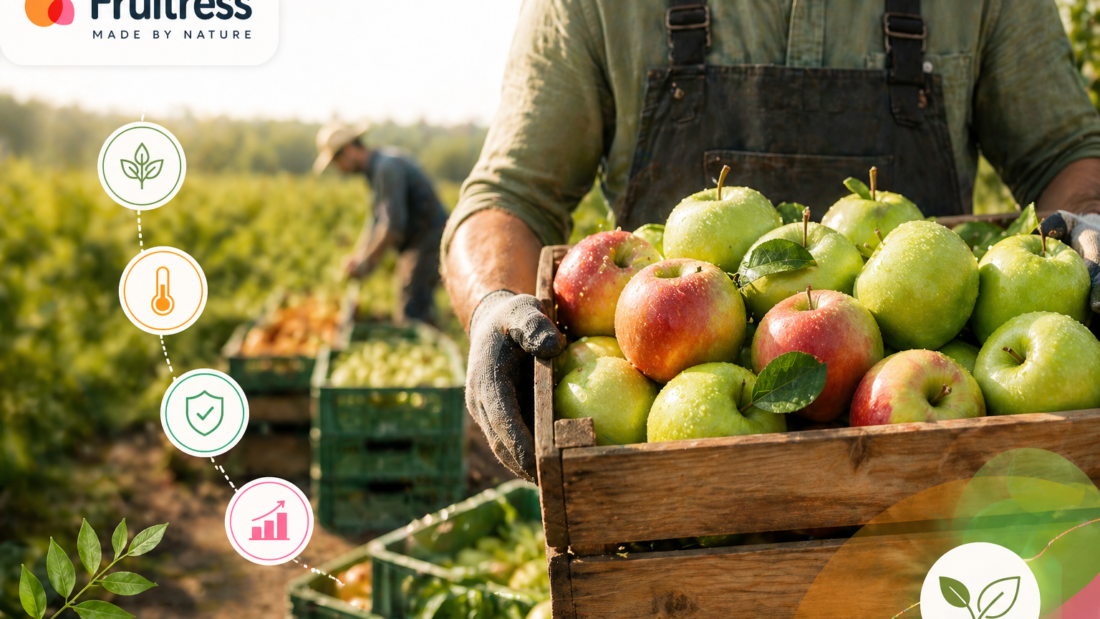
Fruitress professional supply chain dashboard showing ROI analytics for post-harvest loss reduction

The ROI of Sustainability: Why Bio-based Preservation is a Financial Win

In the rapidly evolving landscape of global AgTech, the conversation around sustainability is undergoing a fundamental shift. For years, it was treated as a moral imperative or a marketing layer—a way to satisfy ESG (Environmental, Social, and Governance) requirements. However, as supply chain volatility increases and global margins tighten, sustainability is being redefined. It is no longer just about “doing good”; it is about operational resilience and fiscal intelligence.

At Fruitress, we recognize that for a business to be truly sustainable, it must first be profitable. The introduction of bio-based edible coatings represents a paradigm shift in how we approach post-harvest management, moving from reactive loss mitigation to proactive value preservation.

1. The Invisible Drain: The True Economics of Post-Harvest Loss

In traditional agricultural supply chains, “shrinkage” is often categorized as an inevitable cost of doing business. But a deeper financial audit reveals a much more aggressive reality. When produce spoils, the loss is not merely the cost of the raw commodity; it is a compounding loss that includes:

  • Embedded Input Costs: The water, fertilizer, energy, and labor already invested in the product.
  • Logistical Waste: The fuel and operational expenses used to transport a product that will never reach a consumer.
  • Opportunity Cost: The lost revenue from the sale of that specific unit, combined with the potential loss of future customer trust due to inconsistent quality.

For high-value perishables, these compounded losses can erode up to 30% of potential net profit. Bio-based preservation acts as a financial shield, directly intercepting this leakage and converting potential waste back into realized revenue.

2. Maximizing Operational Margins through Technological Integration

A common misconception among operations managers is that advanced preservation requires a complete overhaul of existing infrastructure. We have engineered the Fruitress solution to bypass this “capital expenditure trap.”

Our technology is designed for seamless integration. Whether through automated spray tunnels or controlled dipping lines, our coatings apply with precision and speed, maintaining your current throughput levels. This allows for:

The Efficiency Equation:
(Increased Yield + Extended Shelf Life) ÷ (Current Operational Cost) = Exponential Margin Growth.

By stabilizing the respiration rate of the fruit, you reduce the frequency of “emergency” interventions and create a more predictable, rhythm-based production cycle. This predictability is the cornerstone of lean manufacturing in the food sector.

3. Unlocking Global Markets: The Logistics Advantage

For exporters, the greatest enemy is the “shelf-life clock.” This clock dictates your logistics strategy, often forcing a choice between two undesirable options:

  1. High-Cost Air Freight: Maintaining freshness through speed, which destroys profit margins and increases carbon footprints.
  2. Low-Cost Sea Freight: Utilizing cheaper routes but risking massive spoilage and product degradation before arrival.

Fruitress technology provides a third way. By effectively “pausing” the metabolic decay of the produce, our coatings allow you to utilize sea freight for premium products that previously required air travel. This doesn’t just lower your shipping costs; it opens up entirely new geographic territories. You are no longer limited by the speed of your transport, but by the reach of your strategy.

4. ESG as a Strategic Competitive Advantage

We are entering an era of “Regulated Sustainability.” From the EU’s strict packaging directives to global carbon taxing, the cost of “business as usual” is rising. Companies that fail to adapt to a low-waste, plastic-free model are not just hurting the planet—they are creating massive legal and financial liabilities for their shareholders.

Integrating bio-based preservation allows your organization to:

  • Mitigate Regulatory Risk: Stay ahead of plastic bans and waste reduction mandates.
  • Enhance Brand Equity: Align with the growing consumer demand for “Clean Label” and eco-friendly products.
  • Attract Green Investment: Improve ESG scores, making the company more attractive to institutional investors and ESG-focused funds.

Conclusion: The Strategic Imperative

The decision to implement advanced bio-based preservation is no longer a matter of environmental altruism; it is a matter of strategic survival. In a global market defined by volatility, the ability to control the shelf life of your product is the ability to control your destiny.

The math is clear. The technology is proven. The market is waiting. The question for leadership is simple: Will you continue to absorb the costs of waste, or will you invest in the science of preservation?

Ready to Protect Your Margins?

Contact the Fruitress technical team to discuss how our solutions can be integrated into your specific supply chain.
Request a Technical Consultation

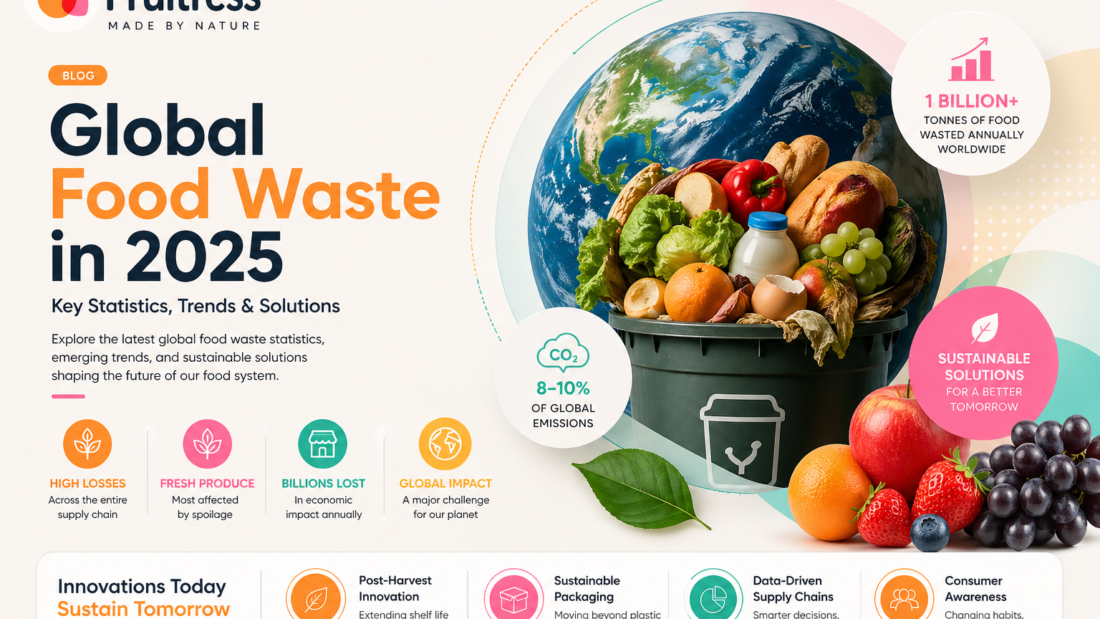
Infographic visualization showing the global food supply chain, highlighting the impact of post-harvest waste and innovative preservation solutions.

The Global Food Waste Crisis: 2025 Challenges and Innovation Trends

Food waste remains one of the most urgent and overlooked challenges in the global food system. In 2025, despite significant strides in agricultural efficiency and digital logistics, a massive portion of the world’s food production never reaches the consumer’s plate.

Understanding the scale, the underlying causes, and the emerging technological trends is essential—not only for policymakers but for every stakeholder in the supply chain, from farmers to food-tech innovators.


The Scale: How Much Food Is Wasted Globally?

Recent data indicates that more than 1 billion tonnes of food are wasted annually worldwide. This represents nearly 20% of all food available to consumers—a staggering figure that translates into massive economic and environmental losses.

This waste is systemic and occurs at every touchpoint:

  • On-Farm: Harvesting inefficiencies and grading standards.
  • Logistics: Spoilage during transit due to temperature fluctuations.
  • Retail: Overstocking and rigid aesthetic standards.
  • Consumer: Purchasing habits and improper storage.

Regional Disparities: A Tale of Two Systems

While food waste is a global pandemic, its drivers differ drastically by geography:

Developed Markets (North America, Europe)

Waste is concentrated at the retail and consumer levels. It is often driven by “cosmetic perfection” (discarding produce that doesn’t meet visual standards) and high-volume over-purchasing.

Emerging Markets (Asia, Latin America, Africa)

The primary challenge is post-harvest loss. Due to limited cold-chain infrastructure and inefficient transport, produce often spoils before it can even leave the production region.


The Hidden Cost: Environmental Impact

Food waste is not just a logistical failure; it is a major climate driver. When food is discarded, the resources used to grow it—water, land, labor, and fuel—are squandered.

Furthermore, organic waste in landfills generates methane, a potent greenhouse gas. Globally, food waste contributes approximately 8–10% of total greenhouse gas emissions, making it a critical focus area for climate change mitigation in 2025.

Why Fresh Produce Is the Most Vulnerable

Fresh fruits and vegetables are highly perishable. They continue to “live” and breathe (respiration) after harvest. Key spoilage factors include:

  • Moisture Loss: Leading to shriveling and weight reduction.
  • Oxidation: Causing browning and nutrient loss.
  • Ethylene Sensitivity: Accelerating the ripening cycle.

2025 Trends: Shifting the Paradigm

As the industry pivots toward sustainability, four trends are leading the reduction movement:

  1. Advanced Post-Harvest Tech: Moving beyond basic cold storage.
  2. Sustainable Packaging: A rapid shift from plastic toward bio-based, edible alternatives.
  3. Data-Driven Supply Chains: Using AI for predictive inventory management.
  4. Conscious Consumerism: Growing market demand for sustainability-backed products.

The Breakthrough: Edible Coatings

One of the most promising solutions in 2025 is the integration of plant-based edible coatings. By creating an invisible, breathable barrier, these coatings regulate moisture, oxygen, and ethylene—effectively “pausing” the aging process of produce.

Is Your Supply Chain Optimized for 2025?

Innovations like Fruitress are enabling producers and distributors to deliver fresher, longer-lasting products while significantly reducing the carbon footprint of their operations.

Schedule a Consultation

Conclusion

Food waste in 2025 is a critical challenge, but it is also an unparalleled opportunity for innovation. By combining smarter logistics, data-driven decisions, and sustainable technology, the food industry can move toward a future where less is wasted and more is preserved.

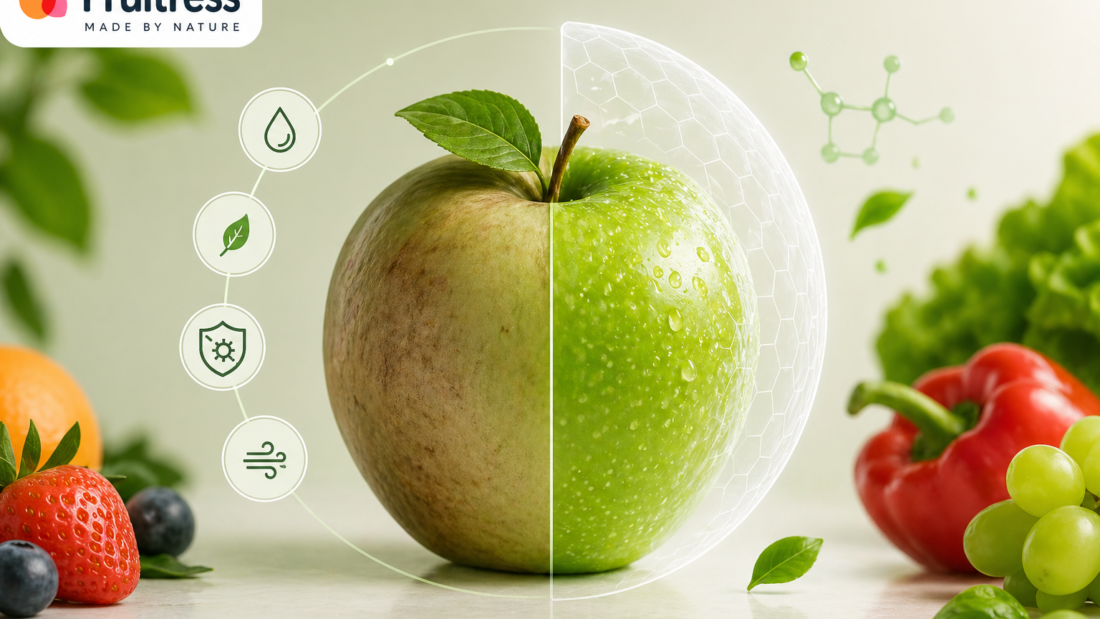
Cross-section scientific illustration showing how Fruitress edible bio-coating creates a protective barrier on fresh fruit against moisture loss and oxidation

How Edible Coatings Work: The Science Behind Longer-Lasting Fresh Produce

Fresh fruits and vegetables begin to deteriorate the moment they are harvested. Despite continuous advances in cold-chain logistics, post-harvest losses remain one of the most critical economic and environmental bottlenecks across the global food supply chain.

In recent years, edible coating technology has emerged as a groundbreaking, sustainable standard to extend shelf life, reduce food waste, and preserve produce quality—without relying on single-use plastics or synthetic chemicals.

But how exactly do edible coatings work at a physiological level? Let’s dive into the science.


What Are Edible Coatings?

Edible coatings are micro-thin, invisible layers formulated from natural, food-grade biopolymers applied directly onto the surface of whole or fresh-cut produce.

Functioning as an artificial “second skin,” these coatings enhance the fruit’s natural cuticle to:

  • Retain internal moisture and prevent dehydration
  • Moderate cellular respiration and gas exchange
  • Inhibit oxidative browning and degradation
  • Suppress microbial colonization and fungal growth

Unlike conventional petroleum-based packaging or toxic synthetic waxes, advanced edible coatings are completely biodegradable, clean-label, and safe for consumption along with the fruit.


The Mechanism: 4 Pillars of Produce Protection

Post-harvest senescence (aging) is driven by metabolic and biochemical processes. Edible coatings slow down these processes through four critical mechanisms:

1. Moisture Retention & Transpiration Control

Water evaporation is the leading cause of post-harvest weight loss and shriveling. As produce loses moisture, it suffers from structural collapse, visual shrinkage, and reduced commercial weight.

Bio-coatings form a semi-permeable lipid-polysaccharide barrier that significantly retards water vapor transmission, ensuring fruit stays firm, crisp, and heavy until it reaches consumers.

2. Regulating Gas Exchange & Oxidation

Exposure to atmospheric oxygen triggers rapid cellular breakdown, causing:

  • Enzymatic browning (especially in apples, avocados, and pears)
  • Breakdown of vitamins (particularly Vitamin C)
  • Off-flavor development

By creating a selective barrier to O2 and CO2, edible coatings limit oxygen penetration, effectively slowing down oxidative reactions without causing internal fermentation or anaerobic decay.

3. Ethylene Regulation (Ripening Control)

Ethylene is the endogenous plant hormone that triggers ripening, softening, and eventually rot. By controlling respiration rates and internal gas concentrations, bio-coatings slow down the autocatalytic production of ethylene, keeping produce in a stable, pre-climacteric state for extended durations.

4. Microbial Defense & Structural Integrity

Surface micro-fractures serve as entry gates for opportunistic mold spores (like Botrytis and Penicillium). Advanced formulations integrate natural antimicrobial agents that create an inhospitable surface environment for bacteria and fungi, preventing decay before it spreads.

Key Takeaway for Commercial Operations

Preserving physical attributes is directly tied to profit margins. A 2x increase in shelf life gives exporters flexible shipping windows and slashes retail shrinkage rates by up to 40%.


Formulation: What Are Modern Coatings Made Of?

Commercial bio-coatings are engineered from natural, food-derived building blocks tailored to specific produce varieties:

  • Polysaccharides (Cellulose, Starch, Chitosan): Provide excellent gas barrier properties and mechanical stability.
  • Lipids & Waxes (Plant Oils, Carnauba): Deliver supreme moisture barriers to arrest dehydration.
  • Plant Proteins: Form cohesive, flexibleExposure to atmospheric oxygen triggers rapid cellular breakdown, causing:
    • Enzymatic browning (especially in apples, avocados, and pears)
    • Breakdown of vitamins (particularly Vitamin C)
    • Off-flavor development

    By creating a selective barrier to O2 and CO2, edible coatings limit oxygen penetration, effectively slowing down oxidative reactions without causing internal fermentation or anaerobic decay.

    3. Ethylene Regulation (Ripening Control)

    Ethylene is the endogenous plant hormone that triggers ripening, softening, and eventually rot. By controlling respiration rates and internal gas concentrations, bio-coatings slow down the autocatalytic production of ethylene, keeping produce in a stable, pre-climacteric state for extended durations.

    4. Microbial Defense & Structural Integrity

    Surface micro-fractures serve as entry gates for opportunistic mold spores (like Botrytis and Penicillium). Advanced formulations integrate natural antimicrobial agents that create an inhospitable surface environment for bacteria and fungi, preventing decay before it spreads.

    Key Takeaway for Commercial Operations

    Preserving physical attributes is directly tied to profit margins. A 2x increase in shelf life gives exporters flexible shipping windows and slashes retail shrinkage rates by up to 40%.


    Formulation: What Are Modern Coatings Made Of?

    Commercial bio-coatings are engineered from natural, food-derived building blocks tailored to specific produce varieties:

    • Polysaccharides (Cellulose, Starch, Chitosan): Provide excellent gas barrier properties and mechanical stability.
    • Lipids & Waxes (Plant Oils, Carnauba): Deliver supreme moisture barriers to arrest dehydration.
    • Plant Proteins: Form cohesive, flexible #cbd5e1; color: #dc2626;”>High Waste / Non-RenewableModerateConsumer SafetyClean-Label & Food-GradeHigh (External)Chemical Residue ConcernsCarbon ImpactModerateConsumer SafetyClean-Label & Food-GradeHigh (External)Chemical Residue ConcernsCarbon ImpactMinimalExtremely HighMediumSupply Chain Scalability
      Ready to integrate bio-coatings into your packhouse workflow?Get in Touch with Our Agritech Team
    • Discover how Fruitress custom formulations can double your produce shelf life and minimize post-harvest loss.
Farmer using a spray system to apply Fruitress edible coating on fresh produce to reduce post-harvest loss

Post-Harvest Loss, Farm Profitability, Crop Preservation, Agricultural Efficiency, Supply Chain Management, Fruitress, Yield Optimization

Beyond the Harvest: Transforming Losses into Profitability

For modern agricultural operations, the harvest is only half the battle. A significant portion of yield is lost between the field and the consumer—a phenomenon known as post-harvest loss. In a competitive market, these losses represent not just wasted produce, but wasted labor, water, and capital.

Reducing these losses is no longer just a “best practice”—it is the most direct path to increasing farm profitability without expanding acreage or increasing production costs.

The Physiology of Loss: Why Produce Deteriorates

To manage loss, one must understand the biology of the crop. After harvest, fruit remains a living organism, consuming oxygen and releasing carbon dioxide—a process called respiration. If not controlled, this leads to rapid senescence (aging). Key drivers of loss include:

  • Transpiration: The loss of internal moisture, which causes shriveling and significant weight reduction.
  • Ethylene Exposure: A natural plant hormone that accelerates ripening and decay, often triggered by bruising during handling.
  • Microbial Proliferation: Micro-fractures and surface damage act as entry points for pathogens, causing rapid rot.

Strategic Management: 5 Steps to Protect Your Yield

1. Precision Harvesting Cycles

Timing is a critical variable. Harvesting during the coolest part of the day minimizes field heat, effectively starting the shelf-life clock on better terms. Early morning harvests often retain higher turgor pressure, leading to better structural integrity.

2. Mitigation of Micro-Bruising

Physical damage is often invisible to the naked eye but catastrophic for shelf life. Standardizing container density, reducing drop heights during transfers, and ensuring smooth transit surfaces can drastically reduce internal bruising.

3. Optimized Cold Chain Integration

Rapid cooling—often called “pre-cooling”—is essential. Even a few degrees of difference in initial storage temperature can exponentially slow metabolic rates and moisture loss. For smaller operations, simple passive cooling (ventilation and shade) is the necessary baseline.

4. Segregation Protocols

Never mix produce types in storage. Ethylene producers (like apples) can inadvertently ripen ethylene-sensitive crops (like leafy greens), creating a chain reaction of spoilage across your inventory.

5. Advanced Barrier Technologies

Traditional methods are reaching their physical limits. The integration of plant-based edible coatings is the new standard for proactive loss prevention. Technologies like those developed by Fruitress act as a “second skin” for produce.

The Fruitress Advantage: Molecular Protection

Fruitress coatings create a breathable, natural barrier that moderates respiration and moisture loss. By applying this solution—via simple spray or dip systems—farmers can:

  • Extend Shelf Life: Up to 2x, providing more flexibility in shipping.
  • Enhance Market Access: Deliver consistent, high-quality produce to more distant retailers.
  • Decrease Waste Costs: Significantly reduce the percentage of inventory discarded at the retail level.

The Economic Impact: Profitability Through Preservation

Reducing post-harvest loss is essentially an immediate revenue increase. When you reduce loss by 10%, you are not just saving 10% of your crop—you are securing 10% more sellable volume from the exact same input costs. This increases your margin per hectare and provides a distinct competitive advantage in wholesale and export markets.

Conclusion

Post-harvest loss is not an inevitable tax on agriculture; it is a management challenge with clear, technology-driven solutions. By combining careful handling with modern, plant-based preservation, farmers can capture more value from every harvest.

Ready to increase your marketable yield?
Schedule a Technical Consultation